

Juvenile Idiopathic Arthritis (JIA) affects every child differently. Some children may have inflammation in just one joint, while others may experience symptoms in multiple joints throughout the body. Depending on the subtype of JIA, muscles, tendons, and other parts of the body may also be affected. For example, children with Systemic JIA (SJIA) may experience symptoms such as recurring fevers, rashes, and general feelings of illness in addition to joint inflammation.
Recognising JIA in young children can sometimes be challenging. Children do not always complain of pain and may instead seem unusually tired, irritable, reluctant to play, or less interested in food. Parents and carers may notice a limp, favouring one side of the body, or difficulty using their hands during everyday activities and play.
One of the most common symptoms of JIA is stiffness, particularly first thing in the morning or after periods of rest. A child may find it difficult to get out of bed, walk downstairs, or move around comfortably when they first wake up, but seem to improve as the day goes on and their joints loosen up.
Joint swelling is another important sign and may occur with or without pain. Because pain is not always a prominent symptom, affected joints can sometimes be difficult for families—and even healthcare professionals—to identify in the early stages.
JIA is often an unpredictable condition, with symptoms that can change over time. Children may experience periods when the disease is more active (known as flares), followed by times when symptoms improve significantly or disappear altogether (remission). For this reason, treatment plans and monitoring are tailored to each child’s individual needs and may change over time to ensure the best possible outcomes.
Leaflets
What is JIA? Leaflets to download
JIA statistics
Incidence: The number of new patients diagnosed as having JIA each year is approximately 1 in 10,000 in the UK.
Prevalence: The number of children known to have JIA is about 1 in 1,000. (12,000 children under 16)
Arthritis can start at any age from birth to adolescence, but the peak age of onset is 6 years.
Both girls and boys may be affected but overall JIA is more common in girls.
Types of JIA
The International League of Associations for Rheumatology (ILAR) classification system identifies seven subtypes of Juvenile Idiopathic Arthritis (JIA). Each subtype has distinct characteristics and may affect children of different ages and sexes. An overview of each subtype is provided below.
Polyarticular JIA
Polyarticular Juvenile Idiopathic Arthritis (JIA) affects five or more joints and accounts for around 20% of JIA cases. It can develop at any age during childhood and is more common in girls than boys.
This type of JIA often affects the small joints of the hands and feet, causing pain, swelling, and stiffness. Tendons in the hands may also become inflamed, making everyday activities more challenging. When the joints in the legs and feet are affected, children may experience difficulties with walking, while involvement of the hands and wrists can impact tasks such as writing, drawing, and other fine motor activities. During periods when the disease is active, children may also feel generally unwell and experience fatigue or fevers.
Treatment typically includes disease-modifying anti-rheumatic drugs (DMARDs), biologic therapies, or other medications that help control inflammation and prevent long-term joint damage. Early diagnosis and treatment are important to achieve the best possible outcomes.
A small proportion of children with polyarticular JIA test positive for rheumatoid factor (RF), an antibody found in the blood. This subtype, known as rheumatoid factor-positive polyarticular JIA, can be more severe and may require prompt and intensive treatment to reduce the risk of joint damage and maintain joint function.
Oligoarticular JIA
Oligoarticular Juvenile Idiopathic Arthritis (JIA) is the most common form of JIA, accounting for around half of all cases. It affects four or fewer joints during the first six months of the disease. When only one joint is affected, it is known as monoarticular arthritis. Oligoarticular JIA most commonly develops in children under five years of age and is more frequently seen in girls than boys.
Parents or carers may notice swelling in a joint, stiffness, or a limp, particularly in the morning or after periods of rest. Children may not always complain of pain, which can sometimes make the condition difficult to recognise in its early stages.
Some children with oligoarticular JIA are at increased risk of developing inflammation in the eye, known as uveitis. This condition often causes no obvious symptoms, such as redness, pain, or changes in vision, especially in its early stages. Left untreated, however, uveitis can lead to serious eye complications and vision loss. For this reason, regular eye screening using a slit lamp is an important part of ongoing care, particularly for children who test positive for antinuclear antibodies (ANA).
Because oligoarticular JIA affects only a small number of joints, treatment often includes corticosteroid injections directly into the affected joints to reduce inflammation and relieve symptoms. The outlook for many children is positive, with good control of the disease and long periods of remission. However, some children go on to develop arthritis in additional joints over time. This is known as extended oligoarticular JIA and may require further treatment, including disease-modifying medications or biologic therapies.
T
Systemic JIA
Systemic Juvenile Idiopathic Arthritis (JIA) affects around 10% of children with JIA and can develop at any age during childhood.
Unlike other forms of JIA, systemic JIA affects the whole body as well as the joints. A key feature is recurring high fevers, which often occur once a day and can reach 40°C or higher. These fevers are frequently accompanied by a distinctive pink rash that may appear and disappear, often in line with the fever episodes.
Children with systemic JIA may also experience inflammation in other parts of the body. Lymph nodes can become swollen, and inflammation may occur around the heart (pericarditis) or lungs (pleuritis). Some children develop arthritis at the onset of the illness, while in others joint symptoms appear later.
Systemic JIA can make children feel very unwell, particularly during active periods of disease. Prompt diagnosis and treatment are important to control inflammation and prevent complications. Treatment may include corticosteroids, disease-modifying medications, and biologic therapies that target the underlying inflammation. With appropriate treatment and ongoing specialist care, many children are able to achieve good disease control and maintain an active lifestyle.
Enthesitis-Related Arthritis (ERA)
Enthesitis-Related Arthritis (ERA) is a subtype of Juvenile Idiopathic Arthritis (JIA) that most commonly affects boys over the age of eight.
In addition to causing arthritis, usually in the larger joints of the legs such as the knees, hips, and ankles, ERA is characterised by inflammation where tendons and ligaments attach to bones. These attachment points are known as entheses, and inflammation in these areas is called enthesitis. Children and young people may experience pain and tenderness around the heels, soles of the feet, knees, or other tendon insertion sites.
Some children with ERA may also develop inflammation in the eye called acute anterior uveitis. Unlike the eye inflammation associated with some other forms of JIA, this type of uveitis often causes noticeable symptoms, including eye redness, pain, sensitivity to light, and blurred vision. Prompt medical attention is important if these symptoms occur.
Many young people with ERA test positive for a genetic marker known as HLA-B27. While this genetic marker does not cause the condition on its own, it is commonly associated with this subtype of JIA.
The course of ERA varies from person to person. For some children, symptoms improve or resolve during childhood. For others, inflammation may continue into adulthood and affect the sacroiliac joints (where the spine meets the pelvis) and the spine itself. This group of conditions is known as spondyloarthritis.
Treatment focuses on controlling inflammation, relieving pain, maintaining mobility, and preventing long-term joint damage. This may include physiotherapy, anti-inflammatory medications, disease-modifying drugs, and biologic therapies where needed.
Psoriatic JIA
Psoriatic Juvenile Idiopathic Arthritis (JIA) occurs in children and young people who have psoriasis, a chronic skin condition that causes red, scaly patches on the skin, or who have a close family history of psoriasis, such as a parent or sibling with the condition.
In some cases, arthritis develops before any signs of psoriasis appear, which can make diagnosis more challenging. As a result, doctors will often consider both joint symptoms and family history when assessing a child for this subtype of JIA.
Psoriatic JIA can affect a small number of joints or involve many joints throughout the body. Some children may also experience swelling of an entire finger or toe, known as dactylitis, sometimes referred to as a “sausage digit.” Changes to the fingernails or toenails, such as pitting or ridging, may also occur.
The severity and course of psoriatic JIA can vary considerably from one child to another. Some children experience mild symptoms that respond well to treatment, while others may require ongoing management to control inflammation and protect joint health. Treatment may include physiotherapy, disease-modifying medications, and biologic therapies, depending on the severity of the condition.
With early diagnosis, appropriate treatment, and regular monitoring, many children with psoriatic JIA are able to manage their symptoms effectively and maintain an active lifestyle.
For more information on diagnosis, symptoms, treatment and side effects, please click here to read our FAQs for parents/carers.
Our Immune System – The Army Inside Our Body
We are pleased to share Our Immune System – The Army Inside Our Body, a fascinating lecture from the Newcastle University Holmes Lectures series. While the lecture is aimed at children and young people aged 10–14 years, it also provides valuable information for parents, carers, and anyone interested in learning more about the immune system.
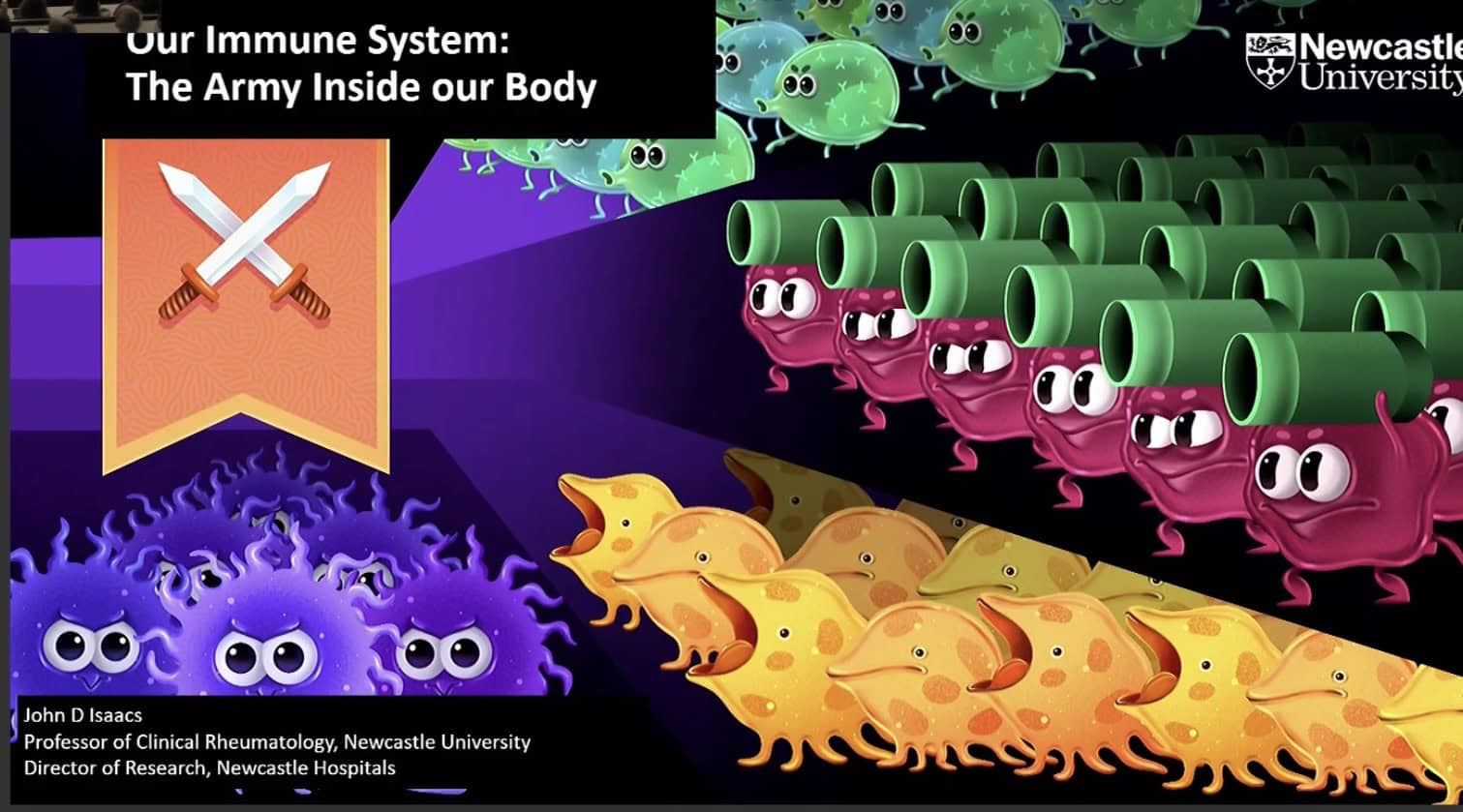
Click on the image above to hear Professor John Isaacs, Professor of Clinical Rheumatology, explain how the immune system protects our bodies, what happens when it does not function correctly, and how autoimmune diseases can develop. He also explores some of the latest advances in treatment and therapy.
The lecture features Dr Flora McErlane, Consultant Paediatric Rheumatologist, and Charlotte, one of Dr McErlane’s patients, who shares her personal experience of living with an autoimmune condition.
We would like to thank Dr Flora McErlane for sharing this excellent resource, and Charlotte for helping to raise awareness of autoimmune conditions through her inspiring story.