

We understand how important research is to the families we support. On this page, you’ll find relevant and up-to-date information about research in Juvenile Idiopathic Arthritis (JIA), uveitis, and paediatric rheumatology.
Scroll down to explore:
- Current research studies seeking participants
- Research surveys that would benefit from your input
- Research reports, findings, and publications
Are you a researcher and would like to involve CCAA or the families we support in your work?
We would be pleased to hear from you. To discuss your research or request support from our community, please complete the Researcher Request Form using the link below.
Why Take Part in Research?
Getting involved in research can be a positive and rewarding experience for both children and their families.
At some point, you and your family may be invited to take part in a research study. Thanks to the families who have participated in research in the past, new treatments have been developed and our understanding of JIA has continued to improve. Research also helps healthcare professionals find better ways to support children and families living with JIA.
Many studies welcome the involvement of siblings too. Taking part can help families feel they are making a positive contribution following their child’s diagnosis, while also helping to improve care and outcomes for other families in the future. It can also provide opportunities to connect with other families who share similar experiences.
Research information sheets and consent forms can sometimes seem long or complicated, but please do not let this discourage you. If there is anything you do not understand, you can always ask the researcher to explain it. No question is too small or unimportant, and researchers are there to help you make an informed decision.
We understand that hospital appointments can already feel busy and overwhelming, particularly when attending with young children. If a researcher approaches you at a time that is not convenient, it is perfectly acceptable to ask for their contact details and arrange to speak with them later. Researchers understand that families have many demands on their time and will usually do everything they can to ensure you feel supported and have the information you need.

‘Your Rheum’ An ongoing research group for young people
If you are aged 11–24 and interested in research, you might like to join Your Rheum. Your Rheum gives young people the opportunity to share their views, contribute to research, meet others with similar experiences, and help make a difference. Watch the short YouTube video to find out more about what happens at Your Rheum.
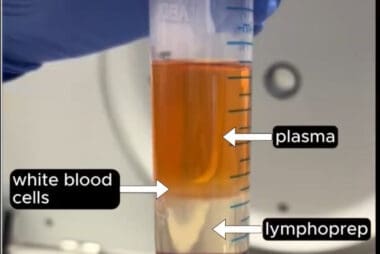
A day in the life of your blood sample
Follow a research blood sample on its journey through the lab in this behind-the-scenes TikTok video, created in collaboration with a young person with JIA. Join researcher Nia to see what happens after a blood sample is given for research. **Please note:** As with all our content, we recommend that parents or carers of younger children watch the video first before sharing it with their child.

Ever Wondered How New Medicines Are Developed?
The Cluster Champions, a group of patients and parents working alongside the Cluster Consortium, have worked with the Cluster Industry Committee and researchers to create this infographic explaining the journey of drug development.
Researchers Need You!
Spotlight on ………
‘Managing Treatment eXperience’ (MTX) study
We are excited to collaborate with researcher Dr Daniela Ghio and Professor of Child Health Literacy, Lucy Bray, on this new project, which puts children and families at the heart of improving treatment experiences for young people living with rheumatic conditions.
The study, funded by the National Institute for Health and Care Research (NIHR), will co-create engaging, child-friendly resources to help children better understand and manage methotrexate. Children, parents, and healthcare professionals have all highlighted the urgent need for better information about methotrexate—designed with children, for children.
“Children have told us that taking methotrexate is one of the hardest parts of their condition,” says Daniela. “This project is about listening to their voices and co-creating tools that make a real difference in their treatment journey.”
Over the next 18 months, the research team will:
- Speak with 40 children aged 6–16 to understand their experiences with methotrexate
- Run creative workshops with children and parents to co-design resources like animations, activity books, and prompt cards
- Test and refine these tools to make sure they’re useful, accessible, and empowering
All details about this project can be found at www.mtxstudy.co.uk
The Childhood Uveitis Research Priorities Survey (CHURP)
Dr Lola Solebo is leading this important work around uveitis research.
Initial findings from the survey have just been shared with us – click here to read more.
More detailed reports from the survey are still being prepared and we will share them here as soon as they are available.
Thanks to Dr Solebo and her team!
IMPACT Study for Families
This is a current study aiming to produce a chatbot support tool for parents who have a child diagnosed with a paediatric rheumatological condition.
IMPACT are often looking for young people, siblings and parents to help them with this important work.
For more info you can see their video here: https://www.theimpactstudy.co.uk/
Other Research
Current research studies seeking participants
(Open to: young people aged 13-19, and/or parents/carersLead Researcher: Catherine Cairns Leyman, University of StirlingDetails:Have your say
Join the young people’s advisory group for a study about young people and chronic pain
Who am I looking for? Young people aged 13–19 who live with chronic musculoskeletal (MSK) pain – ongoing pain in your bones, joints or muscles lasting three months or more. That includes conditions like JIA, hypermobility-related pain, chronic back pain and other long-term MSK conditions. Parents and carers of young people with chronic MSK pain are welcome too.
What’s this about? I’m Catherine, a PhD researcher at the University of Stirling. I’m running a study about how young people manage chronic pain in everyday life – not just the medical side, but the real stuff: routines, relationships, identity. Earlier this year, young people from Your Rheum and the JIA Champions helped me check that my interview questions and information sheets made sense. Now the study is about to start, and I want a small group who stay with it.
What would the group do? The advisory group helps decide how the study talks to young people. Things like:
- Which platforms and places the study should use to reach young people, and which it shouldn’t.
- The words and pictures it uses – what sounds real and what sounds like a leaflet.
- What gets made (a short video? something written? both?) and what a young person’s involvement should and shouldn’t look like in public.
- How the findings get shared, so they reach people like you and not just journals.
These are real decisions; where the group says “not like that”, the study changes. The things the group can’t change are the ones ethics committees have fixed – how consent works, how people’s information is protected, and how I keep people safe.
What’s the time ask? A small group of three to six people, meeting online. The first session is planned for October 2026, with a handful of sessions over the following months – each about an hour, at times that work around school, college and work. You can step away at any point.
This is not the research study itself. Nobody in the group is being interviewed or studied. If you’d also like to take part in the study as a participant when it opens, that’s a separate decision with its own information sheet – you can do one, the other, or both.
A few honest boundaries. I’m a researcher, not a clinician, so I can’t give advice about anyone’s pain or care. I read messages on weekdays. If you need someone to talk to now, Childline is 0800 1111 (under-19s), or your GP.
Interested? Get in touch:
Catherine Cairns Leyman
If you’re under 16, I’d ask that a parent or guardian knows you’re taking part; I’ll send a short information note for you and for them before the first session.


Lead Researcher: Esme Purcell, MSc Health Psychology Student, University of Manchester
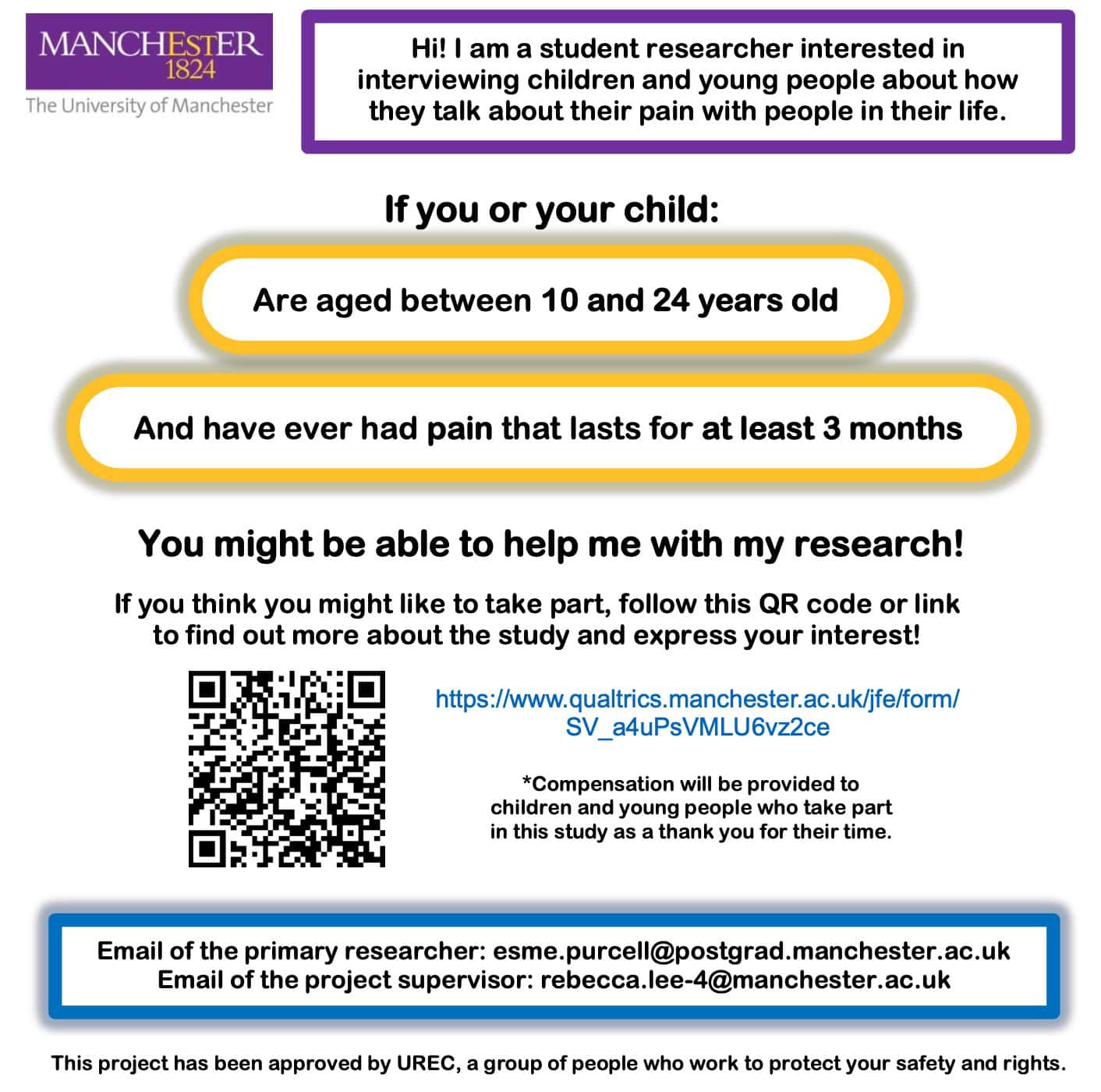
Dr Line Caes, Associate Professor at the University of Stirling, is seeking young people aged 12–24 years with musculoskeletal chronic pain to take part in an interview exploring their self-management practices.
The research team is particularly interested in hearing from younger participants aged 12–16 years, although all young people within the 12–24 age range are welcome to participate.
For participants under the age of 16, parental or guardian consent will be required before taking part.
For more information, please see
We are delighted to be able to share this in person opportunity for families living near Nottingham Trent University. The study is being conducted by Beccie Davis-Yates, Senior Lecturer & Associate Course Lead for Psychology. It has been designed to be a really fun activity session for children using ‘CoNavigator’ – a tool using colourful pegs, tiles and cubes to create a 3D map of everyone’s input!
What’s involved?
Participants will take part in 2 separate, in-person sessions designed to be both interactive and insightful. For children, this involves a 1 hour interactive session tailored to their age and needs, while parents or carers will participate in a separate 1 hour interactive session. These are held independently to ensure that both the children’s voices and the parents’ unique perspectives are fully captured and supported.
Why take part?
By participating in this study, you play a vital role in improving the collective understanding of children’s wellbeing and ensuring that their unique voices are heard. Your shared experiences provide the essential insights needed to develop better support systems for other families in the future. It is an opportunity to contribute to meaningful research that advocates for more compassionate and effective care for children living with chronic health conditions.
For more info and for any questions, please do get in touch with Beccie directly: beccie.davis-yates@ntu.ac.uk
Have some good ideas about what could help families prepare for hospital appointments?
If so, Dr Dani Ghio and MSc Student Kristie Wong at the University of Manchester are working on this as a project and would love to hear from you!
For more information and to share your expertise, please email Kristie.wong@student.manchester.ac.uk
This is run by researchers at the University of Manchester. It includes two studies called Biologics for Children with Rheumatic Diseases (BRCD) and British Society for Paediatric and Adolescent Rheumatology Etanercept Study (BSPAR ETN). These studies aim to look at the safety and effectiveness of biologic and bio similar treatment for Juvenile Idiopathic Arthritis (JIA).
You can read more about information for study participants: https://sites.manchester.ac.uk/bcrdbspar/for-participants/
Design Research Fellow and Product Designer working with Sheffield University, Ursula Ankeny, is interested in figuring out what products might help children and young people living with JIA. She recognises the unmet need for products especially designed for this age group. She aims to work with children and their families to design, trial and disseminate some products! There are online or in-person opportunities available, so it does not matter where you are based.
If you think your child may enjoy getting involved in this, for more information or for any questions, please contact Ursula directly via email at u.ankeny@shu.ac.uk
Research surveys that would benefit from your input
Many of our followers based up North will know Dr Flora McErlane, Consultant Paediatric Rheumatologist based in Newcastle. Dr McErlane has asked us to share this survey with you.
The survey has been put together to find out more about patient experiences and preferences around treatment of non-systemic JIA. Your answers will help them identify what works well, what is difficult, and what matters most to patients and families. The findings will help feed into work that Dr McErlane and others are involved in to improve the treatment and care of people with JIA.
If you would like to contribute, you can find the survey here:
https://redcap.gaslini.org/redcap/surveys/?s=XW99YCJRAAAHACMJ
Research reports, findings, and publications
UK JIA Biologics Register is the collective name for the BCRD Study and the BSPAR Etanercept Study. These research studies look at the long-term safety and effectiveness of treatments for Juvenile Idiopathic Arthritis
To learn more about the different studies, how safe biologic therapies are, and how well they work for children and young people with JIA click on the link below:
https://sites.manchester.ac.uk/bcrdbspar/for-participants/our-discoveries/
In 2012, research teams at University College London (UCL) joined forces with rheumatology clinical teams at University College London Hospital (UCLH) and Great Ormond Street Hospital (GOSH). Together, they established the Centre for Adolescent Rheumatology, co-funded by Arthritis UK (formerly Versus Arthritis) and Great Ormond Street Hospital Charity.
The Centre brings together doctors, nurses, researchers and patients to work collaboratively on research projects focused on adolescent health. This unique partnership has helped pioneer new approaches to improving and transforming rheumatology care and research for young people.
Before this, much of the research in rheumatology focused on adults or younger children. Adolescents were often ‘missing’ from both research and healthcare, creating a significant gap in our understanding of this important period of transition.
You can read more about the Centre’s work in the Centre for Adolescent Rheumatology Impact Report

For the first time, researchers have been studying small samples of tissue from the inflamed joints of children and young people with JIA. This work and the new understanding it brings could pave the way for more personalised treatments, enabling the teams to select the most effective treatment for any individual.
Many of you may have seen the short news item about this on ITV, but if you missed it, you can catch up here
We are sharing the lay summary, a short description of the study with an analysis of this image and what the colours represent.
Our thanks go to the children, young people and their families involved for allowing researchers to use their joint tissue. We would also like to thank the research teams involved from the University of Birmingham, University College London, Birmingham Children’s Hospital, Great Ormond Street Hospital and University of Oxford.